If you need to work with datasets that may need to scale to large-scale spatial computation, or complex raster + vector processing—you've probably hit the limits of traditional GIS tools. Wherobots solves this by enabling you to process planetary-scale spatial data, whether that’s continent+ buildings footprints, road networks, GPS driven IoT or movement, or combining those data types with continuous, high resolution raster data, e. And now, with Felt's native Wherobots integration, you can turn those massive computations into interactive maps, dashboards, and spatial applications in seconds, all supported by AI driven assistance.
Why traditional GIS can't handle complex, multi-dimensional data workflows
Organizations are dealing with complex operations on spatial data. Increasingly they need to understand an ever heterogeneous data estate. Analysis of ride-share patterns across dense cities and urban networks across a continent, processing satellite imagery for broad-scale climate analysis - combined with building footprints or parcel assets, and connecting that analysis by running spatial joins across billions of IoT sensor readings—these tasks break down with legacy GIS tools and data systems, and require distributed computing infrastructure.
This is where Wherobots comes in. Founded by the original creators of Apache Sedona—a cluster computing system for processing large-scale spatial data that extends Apache Spark and Apache Flink with distributed geospatial capabilities—Wherobots provides managed, highly-scalable Spatial Intelligence Cloud that can handle datasets that frequently crash conventional tools. Apache Sedona has become the de facto standard for large scale spatial computing, with over 2 million downloads per month and adoption by organizations including Amazon, Apple, Uber, Overture Maps Foundation, and the world's largest e-commerce, telecommunications, and data management companies. Wherobots extends that capability to enable answers through a managed service that aids advanced raster processing, data and asset cataloging, connectivity, and more. So once you've crunched the numbers, you can build easy-to-use dashboards that answer business questions fast. This is where Felt comes in as the fastest way to build and ship performant mapping solutions for end users.
Wherobots + Felt: From complete spatial intelligence to instant, AI supported answers
With Felt's new Wherobots integration, you get the best of both worlds: Wherobots' distributed processing power and cataloging service, combined with Felt's powerful data pipeline and cloud-native visualization capabilities that drive adoption of spatial intelligence across the organization. From sales teams, to QA/QCing data outputs, spinning up the spatial applications you need to scale critical business workflows takes minutes versus weeks.
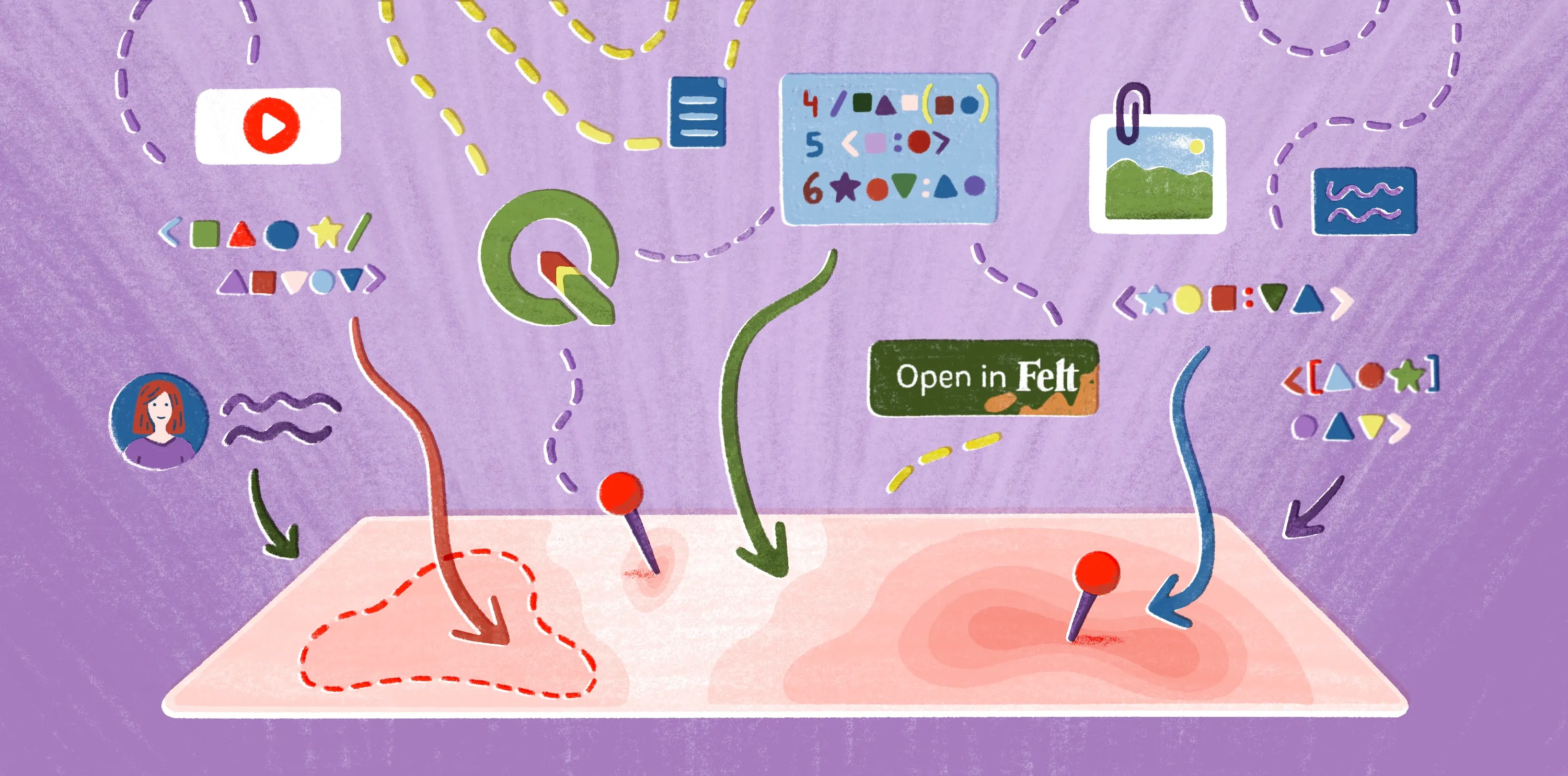
Here's the workflow: run your distributed spatial analysis in Wherobots—whether that's large aggregations and combinations of Raster+Vector data, spatial joins across billions of records, or complex geometric operations. Then connect those results directly to Felt to create interactive maps, collaborative dashboards, or spatial applications easily shared across your team. No data exports, no intermediate steps, no tile server provisioning.
What you can build with Felt and Wherobots
Once your Wherobots data is connected to Felt, you can:
- Query Wherobots with natural language using Felt AI to ask spatial questions without writing spatial SQL—turn big questions like "What buildings were impacted by floods this year?" into beautiful maps and applications in minutes.
- Build real-time dashboards with Components including statistics, bar charts, histograms, and time series that update as you pan and zoom
- Create interactive applications with filters, search, and custom styling—no coding required
- Collaborate instantly by sharing links to live maps instead of static exports or screenshots
Whether you're analyzing transportation networks, modeling environmental risk, or mapping demographic patterns at scale, Felt gives your team self-service access to spatial insights without requiring GIS expertise.
Real-world impact: Leaf Agriculture
Leaf Agriculture shows the power of combining Wherobots and Felt for production-scale geospatial workflows. As they build the API that standardizes fragmented agricultural data for enterprise customers like Syngenta and Bayer, Leaf needs to process massive data lakes of agricultural, parcel, and tractor telemetry datasets spanning millions of acres.
Leaf uses Wherobots and Felt together to turn their massive agricultural data lake into actionable intelligence—processing spatial data at scale with Wherobots, then building interactive maps and dashboards in Felt for their customers. This integration has delivered significant improvements in cost efficiency, scale, and ability to innovate—enabling Leaf to provide insights at scale without the overhead of traditional GIS infrastructure.
The future of geospatial: cloud-native from compute to visualization
This partnership represents where geospatial technology is heading: cloud-native tools that scale from storage to computation to collaboration without forcing teams to cobble together disparate systems or export data between platforms.
With Wherobots handling planetary-scale processing and Felt providing the complete geospatial application layer—from interactive mapping and spatial analysis to dashboards and collaborative GIS—organizations can finally work with massive spatial datasets as seamlessly as they work with spreadsheets. No infrastructure to manage, no GIS expertise required, just powerful spatial applications built in seconds.
See it in action: Building spatial applications with Wherobots & Felt
Want to see this integration in action? Join us for an upcoming webinar where Felt and Wherobots teams will demonstrate how to go from planetary-scale geospatial processing to interactive maps and applications.
Compare Felt using AI