



How to choose the right location through data-driven real estate site selection
Site selection is one of the biggest predictors of commercial real estate success. Developers, brokers, and investors use it to pinpoint locations with the strongest long-term potential for profitability and customer reach. The best way to know whether a property is worth your time and money is by combining real-world context and spatial insights. In doing so, you can minimize risk and maximize return on investment (ROI).
Read on to learn more about the site selection process and how it helps you make confident investment decisions. Plus, see how mapping tools like Felt make it easy to visualize market data and compare multiple sites instantly.
Why real estate site selection matters
The expression, “location, location, location” remains one of the most enduring real estate terms. You can alter a building’s layout and features as much as you like, but the location remains the same. That’s why strategic real estate site selection matters so much. The right site:
- Determines demand, such as who wants to live, shop, or work there.
- Impacts property value growth over time.
- Affects accessibility to customers, employees, and amenities.
- Drives operational success, such as foot traffic for retailers.
Poor site selection can lead to long-term consequences. For example, relying on outdated traffic counts or missing recent zoning changes can lead to regulatory challenges, misalignment with target demographics, and limited accessibility for customers.
A data-backed approach to real estate selection helps you evaluate sites beyond surface-level impressions. Incorporating global information systems (GIS) layers with market intelligence gives you a more complete view of the site, which leads to smarter negotiations and more informed investment decisions.
Key factors that influence site selection
The following criteria provide a practical framework for site selection and analysis so you can take advantage of high-value opportunities and pass on properties that will drain your resources.
Demographics and market trends
Demographics help you understand whether a location aligns with your business model. In commercial real estate, the most common demographics to consider include age, income, and household composition of the surrounding population to see if it supports your intended use. These numbers tell you whether the means and lifestyle of the local population match the property’s intended use.
For example, a luxury apartment complex will attract tenants quickly in a high-income area, while family-friendly homes sell faster when they’re near schools and parks.
In addition to demographics, pay attention to market trends to spot areas with growing demand. Areas with rising population growth often support new retail or mixed-use development. Analyzing these trends helps you identify sites with long-term potential for leasing or redevelopment.
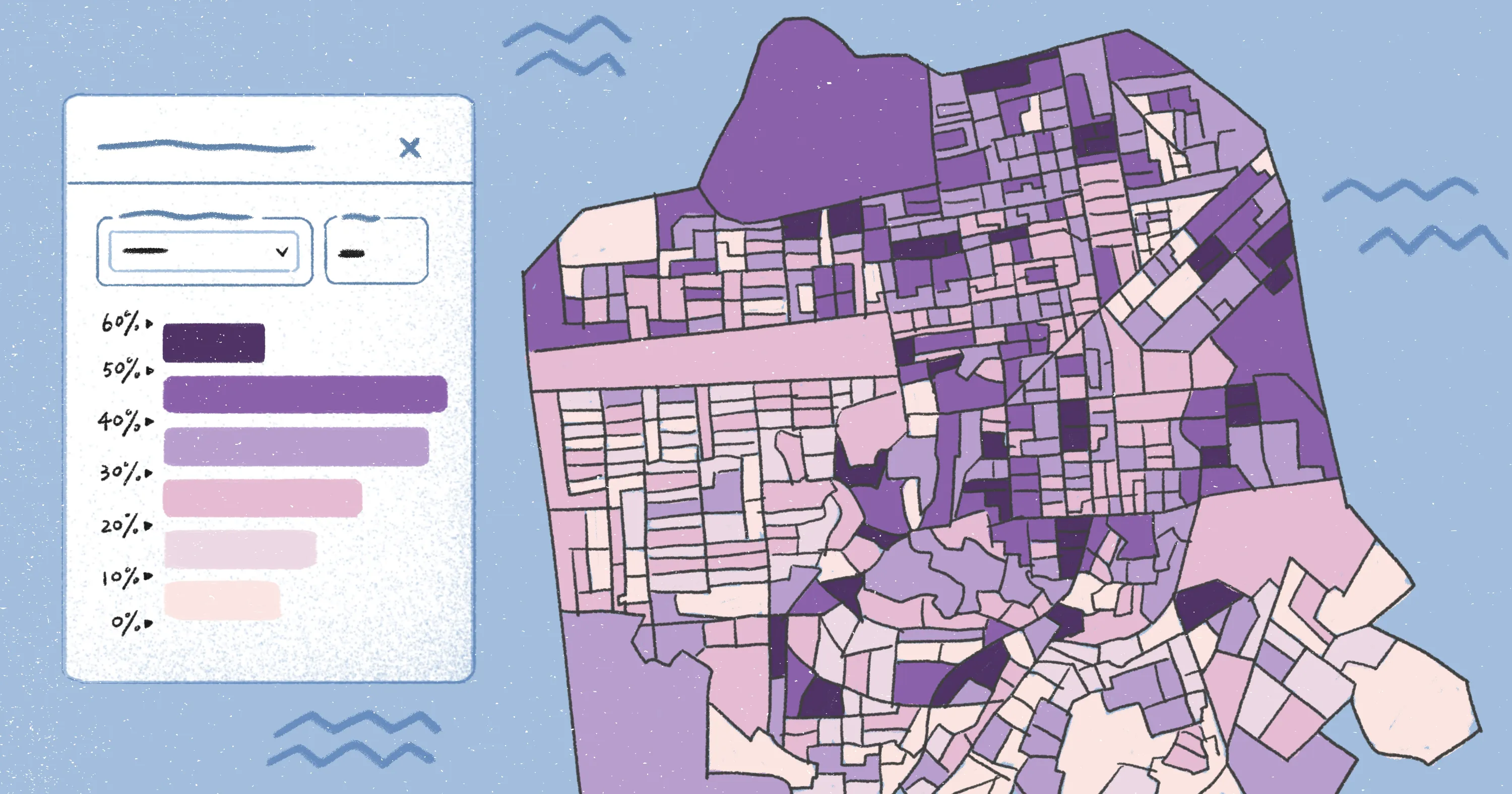
Tools like Felt let you create maps that help you visualize demographic layers and conduct market research in real time. You can click on a point to receive detailed performance insights and prioritize properties that meet both current and future customer needs.
Zoning and land use regulations
Zoning laws determine what you can build on a property and how it can be used. Different zones — like commercial, industrial, or mixed-use — come with specific restrictions. For example, a mixed-use space might welcome shops and offices but not heavy industrial activity.
Knowing these rules ahead of time helps you avoid costly delays and legal headaches. Before you select a site, look at what types of development are permitted and how dense development can be in each area. Studying zoning maps and land use regulations helps you find properties that fit your goals.
Accessibility and infrastructure
Transportation access plays an important role in a property’s success. Sites near highways, public transit, and logistics hubs improve delivery speed and customer convenience.
Reliable utilities like water and electricity are also important considerations and ensure new developments run smoothly from day one. Modern improvements in high-speed internet and upgraded power grids also help you expand or adapt a property as demand grows.
As you evaluate a site’s accessibility and infrastructure, you’re not just looking for convenience; you’re assessing long-term viability. Strong systems make a property more attractive to businesses, residents, and investors.
Competitive landscape
Analyzing nearby businesses and researching their products or services help you understand market saturation. Too many competitors may reduce margins, while a site in an underserved area could attract customers without getting overshadowed by another business.
Mapping competitors reveals gaps in services or product offerings. This helps you tailor your development to local needs. It also allows you to make smarter decisions about a site’s design and amenities. This way, your project fits the local scene and stands out the right way.
Step-by-step real estate site selection process
Choosing the right site starts with a clear strategy. This guide outlines each step of the selection process and shows how using data and spatial intelligence can help you confidently evaluate locations.
1. Define objectives and criteria
Begin by identifying your project goals. This might include attracting foot traffic, supporting logistics, or aligning with local economic development plans. Once you have clear objectives, you can outline the criteria for evaluating each site. Factors like demographics or competition will help you filter locations and focus on high-potential land.
Once you have your objectives and criteria, it’s easier to spot the right opportunities and avoid wasting time on locations that aren’t aligned with your vision. For example, a coffee shop that wants to open a new store might focus on properties near office districts, since they’re likely to catch morning commuters.
2. Gather and analyze spatial data
Next, collect the data needed to size up potential sites. Many Felt users look at datasets like the U.S. Electric Power Transmission Lines to evaluate infrastructure and power availability. The idea is to make sure a location can handle your operational needs.
Felt also provides easy access to parcel data to compare sites by lot size, zoning, and ownership without digging through multiple sources. By layering these insights with demographic and environmental information, you can tackle real estate site analysis for different properties on the same platform.
3. Evaluate candidate sites
With data in hand, it’s time to review each site using your criteria. Identify strengths and weaknesses of each by comparing accessibility, population trends, and zoning rules. This helps you weigh trade-offs and focus on the places that support your broader goals.
4. Conduct site visits and finalize decisions
Visit your top sites to confirm what the data shows. When you’re out in the field, look at details that won’t be captured in the numbers, like traffic, nearby buildings, and the condition of roads and utilities.
During a site visit, you might notice issues like outdated utilities or ongoing construction that limits parking. Pairing these on-the-ground observations with data analysis helps you make confident decisions about next steps for your project.
Visualize smarter site selection with Felt
Good site selection is all about understanding how a location works in the real world. Luckily, Felt simplifies commercial real estate site selection by combining data and collaboration. Here’s how it can help support better decisions:
- Bring all your data together: Layer demographics, zoning, and infrastructure data in one browser-based workspace so site analysis feels intuitive.
- Collaborate in real time: Compare sites and share insights instantly, keeping everyone on the same page and accelerating decision making.
- Use AI to work smarter: Uncover patterns, score potential locations, and streamline site analysis for faster, data-driven decisions.
With Felt, you can integrate spatial data and visualize opportunities to find locations that balance risk with ROI. Watch the webinar on scaling your business to see how Felt makes site selection intuitive and data driven.
FAQ
How does GIS improve the site selection process?
GIS uses spatial and market data to reveal patterns that traditional site analysis often overlooks. By mapping territories, demographics, and competitors with GIS technology, teams can accurately evaluate locations and pinpoint candidate sites.
What data sources are used for real estate site analysis?
Common data sources for site analysis include zoning maps, traffic counts, and infrastructure networks like the U.S. Electric Power Transmission Lines. Using multiple sources gives teams a more accurate view of each site and ensures their selection aligns with specific criteria.
Why is collaboration important in site selection?
Collaboration ensures decisions reflect diverse perspectives when evaluating land and location. Using a shared platform lets teams compare sites side by side, leading to stronger development outcomes and better investment decisions.
Compare Felt using AI






.png)


